

Six months is when play starts to change. A newborn mostly watches. A 6-month-old reaches, rolls, grabs and is getting ready to move. Over the next six months, most babies learn to sit on their own, crawl and pull up to stand, and each of those skills comes from practice on the floor. The right play equipment doesn't teach these skills. It gives your baby a safe place to practice them, at the moment they're ready.
Here's what helps at each stage, how to tell when your baby is ready for it, and what can wait.
Stage 1: Sitting (Around 6 to 9 Months)
What they're learning. Most babies start by sitting with their hands on the floor for balance, then gradually sit without support. They're also reaching, transferring toys between hands and rolling in both directions.
You'll know they're ready for more when they can sit for a while without toppling and start rocking forward onto their hands and knees.
What helps. Floor space, and lots of it. A baby who's learning to sit topples constantly, and a soft, safe area makes that part of the fun. A large playpen does two jobs here: it gives your baby room to sit, roll and reach, and it gives you a few minutes with both hands free.
Our wooden playpens are 63 by 63 inches, designed for ages 6 months to 3 years, and fold flat without tools. The Mirror and Whiteboard playpen adds a shatter-resistant mirror, which babies this age love, and the Sensory Activity Panels playpen gives them spinners and textures to explore while they sit. Our playpen size guide helps you choose between them.
Stage 2: Crawling (Around 7 to 10 Months)
What they're learning. Crawling builds strength in the arms, shoulders and core, and coordination between the two sides of the body. Some babies crawl on hands and knees, some scoot on their bottoms, some army crawl on their bellies. All of it counts.
You'll know they're ready for more when they crawl confidently and start reaching up for the edges of furniture.
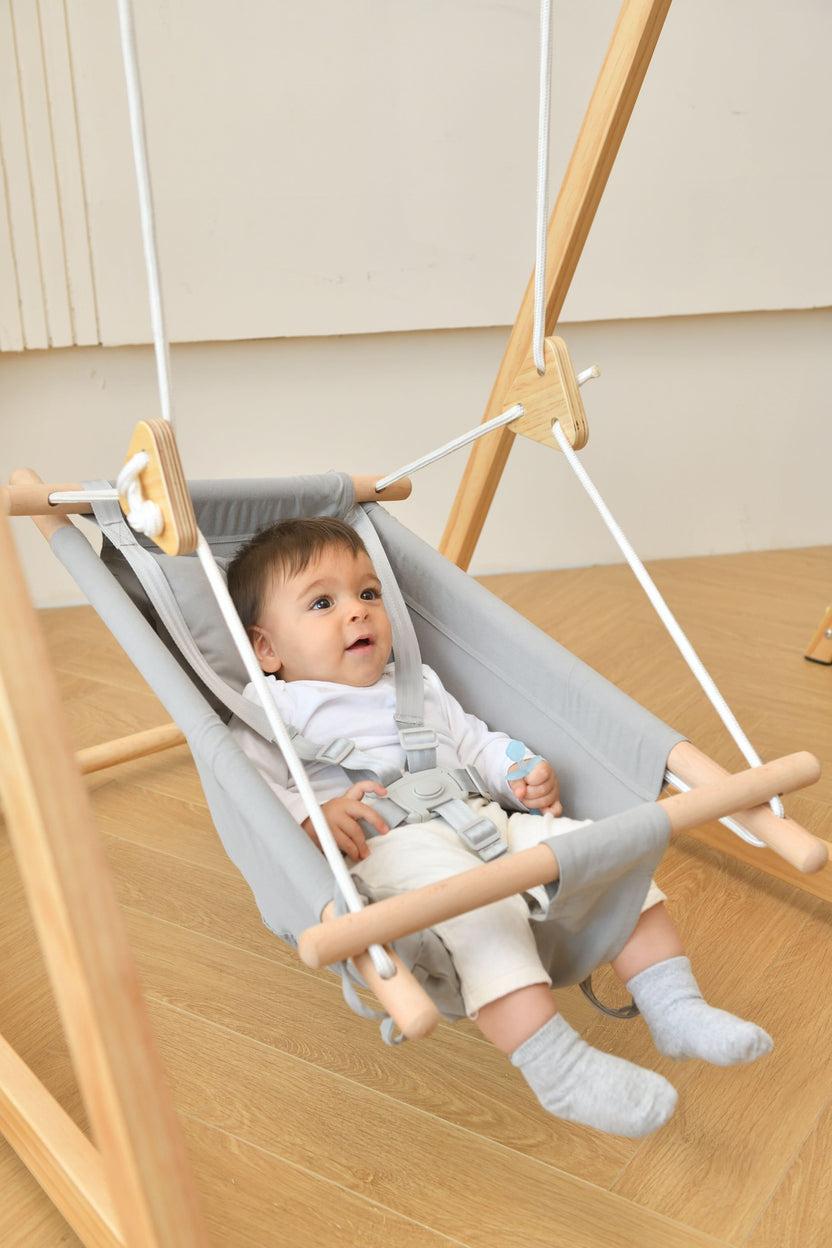
What helps. Distance. Crawlers need somewhere to go. Give them a clear stretch of floor, put an interesting toy just out of reach, and let them work for it. A bigger playpen gives a crawler more room to travel. This is also a good age to introduce a baby swing.
The Spruce is a foldable wooden indoor swing with its own stand, designed for ages 6 to 36 months and up to 33 pounds. It sets up in about 10 minutes and folds flat for storage. The hammock swing fits the same frame, for ages 6 to 36 months, and reclines for slower, calmer swinging. Swinging gives babies a gentle sense of motion that helps develop balance. Always use the harness and stay with your baby while they swing.
Stage 3: Pulling Up and Cruising (Around 9 to 12 Months)
What they're learning. Pulling up to stand, then cruising sideways while holding on to furniture. This is the last big step before walking, and it takes a lot of falling down.
You'll know they're ready for more when they cruise easily and start letting go for a second or two.
What helps. Sturdy things to pull up on. The bars of a wooden playpen are ideal, and the standing bar beside the mirror panel gives babies a handhold at just the right height. Once your baby is pulling up reliably, a push walker gives them something steady to walk behind using their own balance. The Activity Walker and Tool Walker are push walkers. Check the age on each product page before you buy.
Skip seated walkers on wheels. The American Academy of Pediatrics advises against them, and they don't help babies walk sooner. Our post on baby jumpers and activity centers explains why floor time does more.
What Can Wait Until After the First Birthday
| Equipment | Why it can wait | When it fits |
|---|---|---|
| Pikler triangle | Climbing comes after confident standing and cruising | Around 1 year, with sets like the Hazel, designed for ages 1 to 6 |
| Indoor slide | Babies need to climb and sit steadily first | From around 18 months on most toddler slides |
| Jungle gym | Built for walking, climbing toddlers | Most start around age 2 |
| Swedish ladder | Needs confident climbing and grip | From age 1 on some models, like the Walnut |
When the time comes, our guide to play equipment for a 1-year-old picks up exactly where this one ends.

Safety Basics for This Age
- Playpens are for awake play. Move a sleeping baby to their crib.
- Keep the area clear. Nothing within reach of the playpen edge: cords, blinds, outlets, plants or shelves.
- Check every joint and lock before each use, and set the playpen on a flat floor.
- Use the swing harness every time, and stay within arm's reach.
- Follow the age and weight limits on each product.
- Keep tummy time going. The World Health Organization recommends at least 30 minutes a day, spread out, for babies who aren't crawling yet.
Quick Answers
What toys does a 6-month-old need? Simple things to grab, shake and mouth, plus a safe floor space to practice sitting and rolling. Big equipment like a playpen matters more than any single toy at this age.
Is a playpen good for a 6-month-old? Yes, if it's large enough to move in. A roomy playpen gives a baby safe space to sit, roll, crawl and later pull up.
Can a 6-month-old use a swing? Yes, in a swing designed for that age with a secure, supportive seat and harness. Our Spruce and hammock swing are designed from 6 months.
When do babies start pulling up to stand? Many start between 9 and 12 months, though every baby is different. If your baby isn't sitting, crawling or pulling up when you expect, mention it to your pediatrician.
Sources
World Health Organization. Guidelines on physical activity, sedentary behaviour and sleep for children under 5 years of age (2019).
American Academy of Pediatrics, HealthyChildren.org. Baby Walkers: A Dangerous Choice.