

Climbing walls are not just for big kids. A toddler's first climbing wall is often a gently angled ramp with a few holds, and the same child can graduate to a vertical rock wall, a rope wall and eventually a full Swedish climbing wall over the years that follow. The trick is matching the wall to the climber. Here is how kids climbing walls progress, level by level, and how to set one up safely indoors or out.
Level 1: The Angled Ramp (Around 1 to 2 Years)
A toddler climbing wall starts low and sloped. An angled ramp with climbing holds lets new climbers crawl and step their way up while most of their weight stays on their feet and knees. It is the gentlest introduction to rock climbing there is.
Pikler sets often include one. The Hazel has a reversible board with a slide on one side and a rock wall ramp on the other, and the Maple and Bazel each come with a rock climber that hooks onto the triangle. For more on these sets, see our Pikler triangle buying guide.
Level 2: A Low Wall on a Climbing Gym (Around 2 to 3 Years)
Once toddlers are climbing confidently, a short rock wall on an indoor climbing gym adds height without leaving them far from the floor. The wall is one route among several, so children can choose a ladder, a rope or the rock wall as their skills grow.
The Bush 6-in-1 pairs a rock climbing wall with a slide, rope ladder, swing and monkey bars for ages 2 to 6, at just over 59 inches tall. The Magnolia adds a rock wall to a 7-in-1 frame for ages 2 to 6.
Level 3: The Vertical Rock Wall and Rope Wall (Around 3 Years and Up)
Vertical walls are where kids climbing walls get serious. A wall-mounted rock wall or rope wall asks children to pull with their arms, push with their legs and plan each move.
Wall-mounted designs put the most climbing into the least floor space. The Walnut combines a Swedish ladder with a rock wall, rope wall and more on one wall. The Walnut Modular separates them into panels you can mount side by side or around a corner, with add-on rock wall and rope wall panels. The Neem pairs a Swedish ladder with a rope wall for ages 3 to adult, holding up to 250 pounds per person.
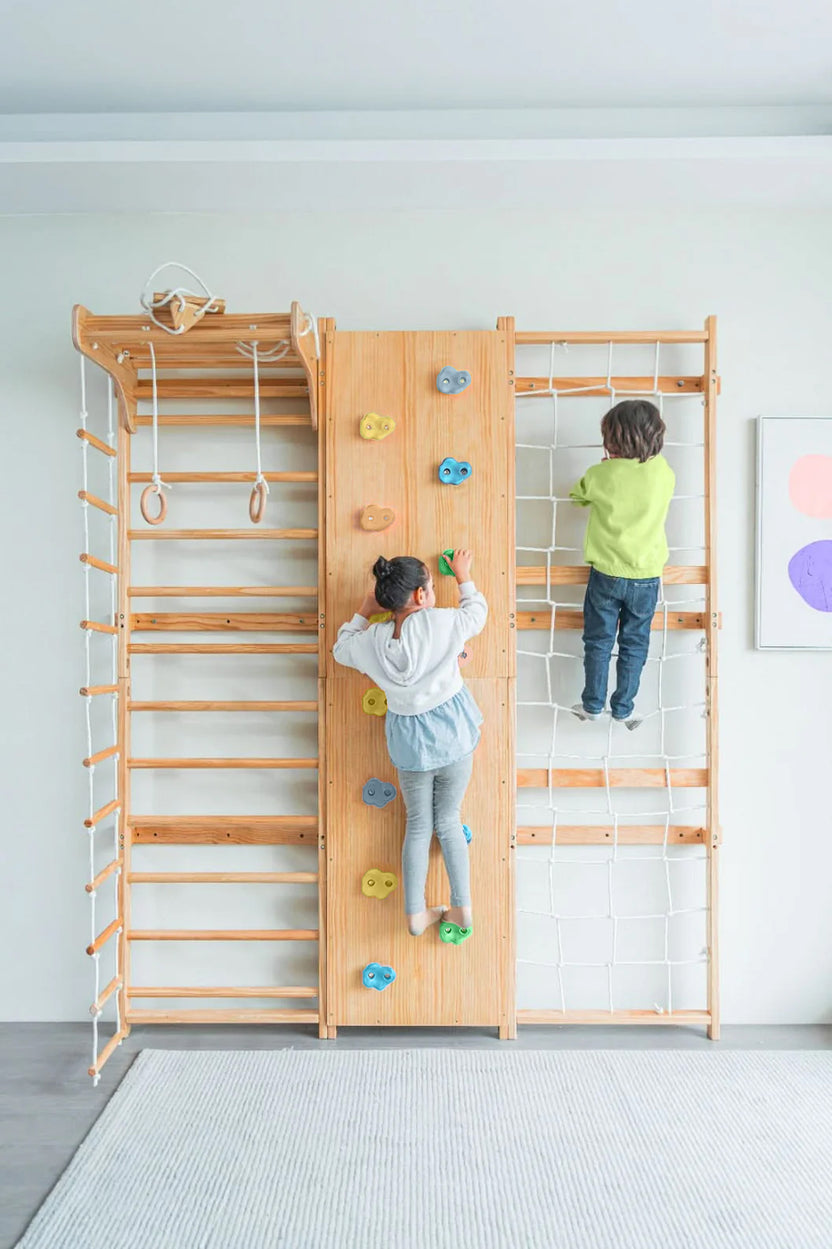
Level 4: The Swedish Climbing Wall (Preschool to Adult)
A Swedish climbing wall, also called a Swedish wall climber, is a tall wooden ladder frame that mounts to the wall, often with a rock wall or rope wall alongside it. It is the climbing wall children grow into rather than out of: young climbers stay low, older children reach the top, and many designs are strong enough for adults to use for stretching. The Betula and Neem come in 79 inch and 94.5 inch heights to fit standard ceilings and basements. Our Swedish ladder vs. indoor jungle gym guide compares them with freestanding climbers.
Outdoor Climbing Walls
Outside, rock walls usually come built into a swing set or playset. The Sycamore Large has an angled rock climbing wall alongside its slide, swings and monkey bars, and the Outdoor Chestnut adds a climbing wall to a foldable cedar jungle gym for younger children.
Kids Climbing Wall Types Compared
| Wall type | Angle | Typical starting age | Where it goes |
|---|---|---|---|
| Rock wall ramp | Low slope | Around 1 year, on sets rated for that age | Attached to a Pikler triangle |
| Low rock wall on a gym | Steep or vertical, but short | Around 2 years | Part of a freestanding climbing gym |
| Vertical rock wall panel | Vertical | Around 3 years | Mounted to the wall |
| Rope wall or cargo net | Vertical, flexible | Around 3 years | Mounted to the wall or a frame |
| Swedish climbing wall | Vertical ladder | Around 3 years to adult | Mounted to the wall |
Always follow the age range and weight limit on the specific product.
How Much Space Does a Climbing Wall Need?
Wall-mounted climbing walls are the most space-efficient. Our Swedish wall designs sit about 26 inches deep without a slide, plus clear space in front for landing. Check two more measurements before you choose: ceiling height, since taller walls need about 8 feet of ceiling and lower ceilings suit a 79 inch wall, and wall width, including where the studs are.
Mounting a Wall Climber Safely
Any wall-mounted climbing wall must be anchored into wall studs, following the manual exactly. Drywall anchors alone cannot hold a climbing child. If your studs are not spaced as the manual expects, or you are unsure about your wall, use a professional installer. After installation, check bolts and holds regularly, and retighten any hold that spins.
What Goes Under a Climbing Wall
Indoors, use a thick, non-slip mat that covers the landing area in front of the wall. The Neem and Betula playset mats are sized for those climbers.
Outdoors, grass and packed dirt are not enough. The U.S. Consumer Product Safety Commission recommends protective surfacing throughout the play area, such as 9 inches of wood chips or mulch or 6 inches of shredded rubber, maintained regularly. Never place a climbing wall over concrete or pavers.
Leveling Up: Making the Wall Harder
A climbing wall can grow with your child. Holds placed closer together make an easier climb; holds farther apart make it harder. Some walls let you move or swap holds to set new routes. Our primary color rocks for the Walnut make it easy to mark routes by color: "today, only climb on red." Adding a rope wall next to a rock wall gives children two different kinds of climb side by side.
Climbing Wall Safety Rules
One climber per route, so no one climbs under or onto someone else.
Climb up, climb down. Teach children to climb down rather than jump from the top.
Bare feet or grippy socks on wooden holds indoors, and no bike helmets or clothing with drawstrings, which can catch on equipment.
Supervise, especially new climbers and mixed ages.
Inspect regularly for loose holds, worn ropes and loose bolts.
Quick Answers
What age can a toddler use a climbing wall? Toddlers can start on a low, angled rock wall ramp from around age 1, on sets rated for that age. Vertical walls are better from around age 3. Always follow each product's age range.
What is the best indoor climbing wall for kids? For small spaces and the longest use, a wall-mounted design with a rock wall, a rope wall and a Swedish ladder. For toddlers, a Pikler set with a rock wall ramp is a better first step.
What is a Swedish climbing wall? A tall wooden ladder frame mounted to the wall, often with a rock wall or rope wall attached. Children climb, hang and stretch on it, and many are strong enough for adults.
Can adults use a kids climbing wall? Only if the product is rated for adult weight. The Neem, for example, is designed for ages 3 to adult and holds up to 250 pounds per person.
Is grass a safe surface under an outdoor climbing wall? No. Grass does not absorb falls well. Use loose-fill surfacing like wood chips, mulch or shredded rubber at the recommended depth.
Explore all our indoor climbers and climbing walls, or compare climbers by age in our climbers buying guide.