

Every new parent eventually wants the same thing: a safe place to set the baby down for a few minutes. Bouncers, rockers and swings all promise that, and they all look a little alike. But they move differently, suit different ages, and come with safety rules that many parents never hear about. Here is what actually separates them, the myths worth letting go of, and how to choose.
Baby Bouncer vs. Baby Rocker vs. Baby Swing
| Baby bouncer | Baby rocker | Baby swing | |
|---|---|---|---|
| How it moves | Gentle up-and-down bounce, often from baby's own kicks | Back-and-forth rocking on a curved base | A seat that swings from a frame |
| What powers it | Baby's movement or a light push | A light push, or baby's movement | A push from an adult |
| Typical stage | Young infants, before sitting up | Infants, and some convert to toddler seats | Babies who can sit with support, through toddlerhood |
| Best for | Short, supervised awake time near you | Calming, and sitting nearby as they grow | Active play and soothing motion |
Myths and Facts Every Parent Should Know
Myth: A bouncer is a safe place for a baby to nap.
Fact: The American Academy of Pediatrics advises that babies sleep on their backs on a firm, flat surface, like a crib or bassinet. Sitting devices such as bouncers, rockers, swings and car seats are not recommended for routine sleep. If your baby falls asleep in one, move them to their crib.
Myth: It is fine to set a bouncer on a table, counter or sofa for a minute.
Fact: Bouncers can shift as a baby moves, and the U.S. Consumer Product Safety Commission warns about falls from bouncers placed on raised surfaces. Always place a bouncer or rocker on the floor.
Myth: The harness is optional for a quick sit.
Fact: Always use the harness or waist strap, every time. Babies can wriggle surprisingly far in a few seconds.
Myth: The more time in a bouncer, the better for development.
Fact: Babies build strength through floor time, especially tummy time, when they can move freely. Use bouncers and rockers for short, supervised stretches, and keep plenty of time on the floor in the day.
Myth: You can keep using a bouncer until your baby reaches the weight limit.
Fact: Stop using an infant bouncer when your baby reaches the age or weight limit on the label, or as soon as they can sit up on their own, whichever comes first. A baby who can sit up can tip a bouncer over.
Myth: A baby swing and bouncer do the same job, so you need both.
Fact: They overlap less than you might think. A bouncer suits young infants for short sits; a swing suits babies who can sit with support and lasts into the toddler years. Many families start with one and add the other later.
Choosing a Wooden Baby Bouncer
A wooden baby bouncer is a quiet, motor-free alternative to plastic bouncers. Babies set it moving with their own kicks, so the motion follows the baby rather than a setting on a dial. The Fir Baby Bouncer has a fir wood frame, a secure harness, three recline positions and a removable play arch. It is designed for babies up to 18 months or 30 pounds, measures 31 by 16 inches, and folds flat to just 4 inches deep, which makes it a good foldable baby bouncer for small homes and trips to the grandparents.

Choosing a Wooden Baby Rocker
A wooden baby rocker rocks gently back and forth with a light push. The Hemlock Adjustable Baby Rocker is made from hemlock wood with a waist strap, and its adjustable legs let you limit or stop the rocking so it works as a steady seat. It converts into a toddler seat as your child grows. Like every rocker, it is for supervised awake time only, not sleep.
A Bouncer That Becomes a Play Gym and Table
If you would rather buy one piece that changes with your baby, the Ivy 3-in-1 starts as a floor play gym for newborns, becomes a supported bouncer and activity center from about 4 to 12 months, then converts into a toddler activity table for about 12 to 36 months. It is made from birch plywood with a removable, machine-washable fabric seat ring.
Baby Swing and Bouncer: When to Add a Swing
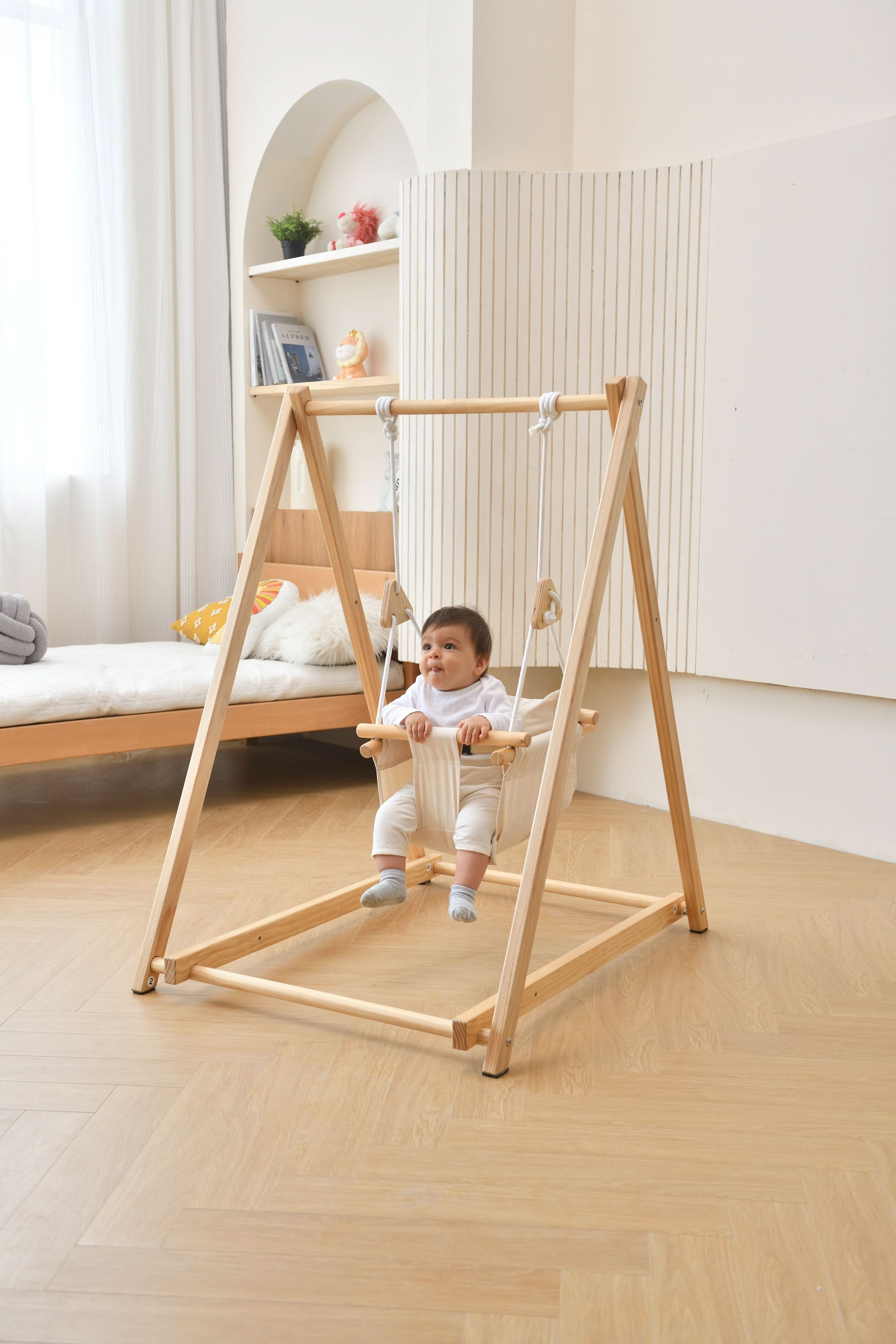
Once your baby can sit with support, usually around 6 months, a seated swing adds a new kind of motion. The Spruce is a wooden baby and toddler swing on its own freestanding frame, for ages 6 to 36 months and up to 33 pounds, made for indoor use. For outdoor options, see our guide to outdoor baby and toddler swings.
Common Questions
What age is a baby bouncer for? Most infant bouncers are made for young babies until they can sit up on their own or reach the label's limits. The Fir is designed for babies up to 18 months or 30 pounds, but stop using any bouncer once your baby can sit up unassisted.
How long can a baby stay in a bouncer? Keep sessions short and supervised, and balance them with plenty of floor and tummy time.
Can a baby sleep in a rocker or bouncer? No. Move a sleeping baby to a crib or bassinet, on their back, on a firm, flat surface.
Is a wooden baby bouncer better than an electric one? A wooden bouncer has no motors or batteries, moves with your baby's own kicks and folds away neatly. Both kinds follow the same safety rules: on the floor, harness on, awake and supervised.
What is the difference between a baby bouncer and a baby rocker? A bouncer moves up and down with a gentle spring; a rocker moves back and forth on a curved base. Both are for supervised, awake time.