Halloween Sale
15% korting op alles· Prijzen zoals aangegeven
Eindigt over
00ddagen
00uuur
00mmin
00ssec
Prijzen zoals aangegevenShop de sale

Toddler Development
Between their first and fifth birthdays, children go from pulling up on the couch to climbing ladders and hanging from bars. Here is what toddlers are typically learning at each age, the play that helps, and the pieces that fit. Every child develops at their own pace, so use the ages as a rough guide and talk with your pediatrician about your child's milestones.
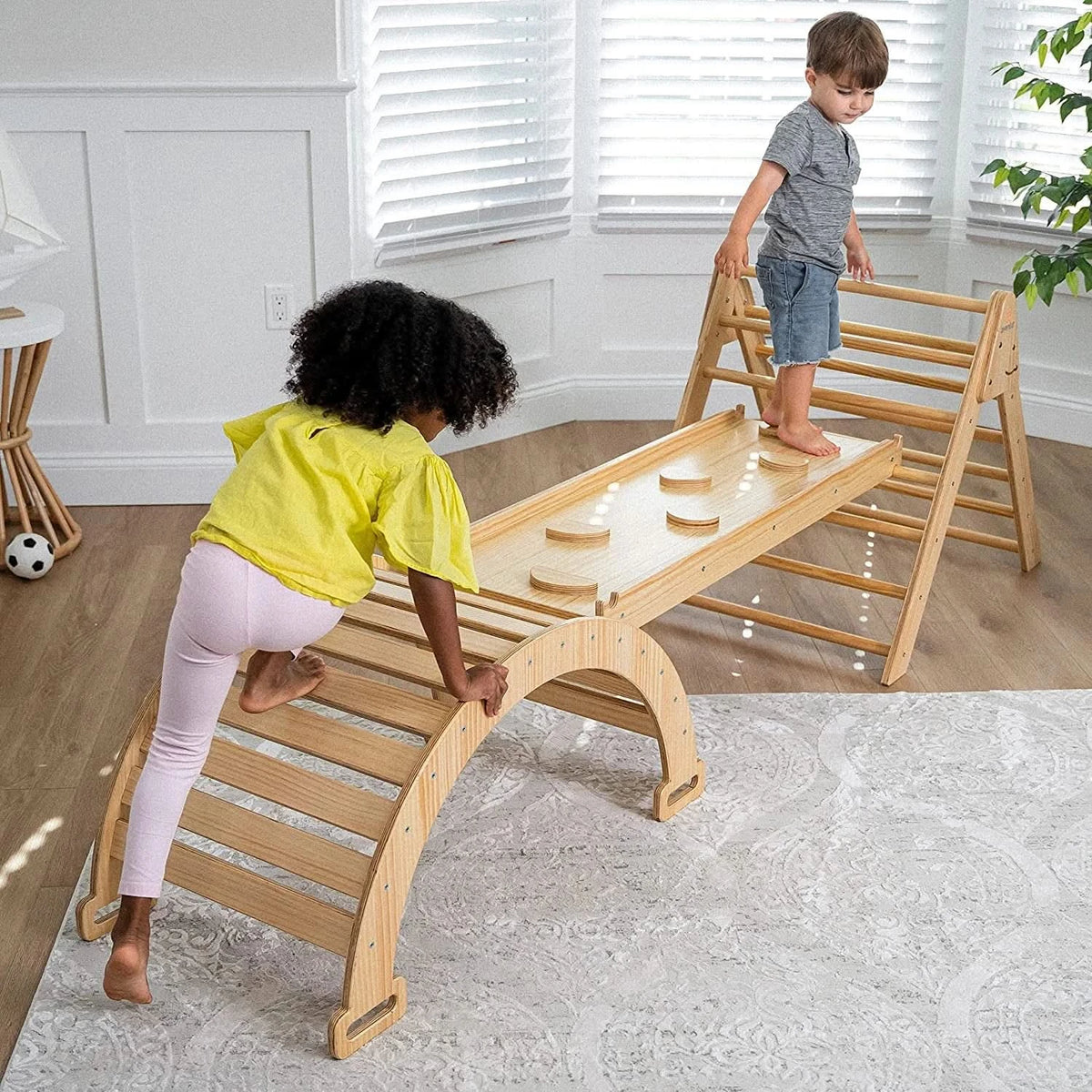
Start Here
Pick your child's age to see what they are learning and what helps.
12 to 18 Months
What your child is learning. Around their first birthday, most children pull up to stand, cruise along furniture and take their first steps. Many start trying to climb onto anything low enough to reach, and each attempt builds leg strength, balance and the confidence to try again.
Play that helps. Low, stable things to pull up on and crawl over. A gentle ramp, a low rung to step on and plenty of floor time give a new walker challenges at the right height.
 Hazel Pikler TriangleMade for ages 1 to 6. A first climber your child sets the height on, one rung at a time.
 Maple Triangle SetA beginner set with a triangle just over 17 inches tall, made for ages 1 to 5.
 Montessori Activity TableSix built-in activities on one round top, made for 12 months and up.
18 Months to 2 Years
What your child is learning. Walking becomes steady, and toddlers start climbing up and, just as important, working out how to get back down. They want to do things themselves and copy what the adults around them are doing.
Play that helps. Short slides, wide steps and real jobs. Climbing up and sliding down becomes a loop toddlers repeat again and again, and standing beside you at the counter turns everyday tasks into practice for hands and focus.
2 to 3 Years
What your child is learning. Two year olds run, kick a ball and start jumping with both feet. Climbing gets bolder, and so does the urge to do everything without help. Pretend play takes off too, as children start acting out the world around them.
Play that helps. Rock walls, rope ladders and swings become usable at this age. A setup with several activities in one frame lets a child move from one challenge to the next, and a corner to play house or shop gives imagination somewhere to go.
 Laurel 4 in 1 Kitchen TowerMade for ages 2 to 6. A kitchen tower that converts into a step stool and a slide.
 Indoor PlaygroundsClimbers with rock walls, slides and swings in one frame. Compare ages and sizes on each set.
 Indoor PlayhousesA space of their own for pretend play, reading and quiet time.
3 to 4 Years
What your child is learning. Preschoolers climb ladders with ease, start to balance on one foot and love an obstacle course. Their play gets more planned, with routes, rules and stories they make up themselves.
Play that helps. Taller climbs, balance challenges and pieces that can be rearranged. A child who builds a new course every day from a ladder, a ramp and an arch is practicing planning as much as climbing.
4 to 5 Years
What your child is learning. By four, many children hop, swing on their own and start working on monkey bars. Grip strength, coordination and stamina all grow quickly, and kids begin to set goals for themselves, like reaching the top rung.
Play that helps. Hanging, swinging and climbing higher. Equipment that adds challenge over time keeps a child interested for years instead of a single season.
 Walnut Swedish Ladder Wall GymFrom 1 year old through the pre-teen years, holding 220 pounds per person. Tested to ASTM and CPSIA standards.
 Monkey Bars for KidsWhen kids are ready for monkey bars and how to teach the skill.
Compare Indoor ClimbersAges, weight limits and sizes for 11 climbers in one table.
Why Climbing Helps
Climbing works the whole body at once: legs push, arms pull and the core keeps everything steady. It also asks a child to plan each move, judge distances and decide when to stop, which is why it builds confidence along with strength. Whatever the age, stay close during climbing play, put a padded mat on hard floors and check each listing for its age range and weight limit.
Questions
Many children are ready for a low climber like a Pikler triangle around their first birthday, once they pull up to stand. Bigger frames with rock walls and swings usually suit children from about 2, and wall gyms with monkey bars suit preschoolers and up. Always check the age range on each listing.
Climbing builds strength, balance and coordination, and it teaches toddlers to plan their moves and judge their own limits. Those small wins add up to confidence.
Open ended pieces that grow with your child do the most: climbers, slides, balance beams and kitchen towers that invite moving, helping and pretending. Toys that do one thing tend to be outgrown quickly.
Convertible pieces stay in use the longest. The Laurel and Plum kitchen towers convert into step stools, a slide or a chalkboard, and the Adrian table and chair set adjusts from 14.76 to 20.9 inches tall.
Most toddlers are ready around 18 months, once they can climb a few steps and stand steadily. The Date tower starts at 18 months, and the Laurel and Plum are made for ages 2 to 6.
Children reach milestones at different times, and the ages here are a rough guide. If you have questions about your child's development, your pediatrician is the best person to ask.
The best gift meets a child where they are and leaves room to grow. See every pick sorted by age, or browse all of our guides.


